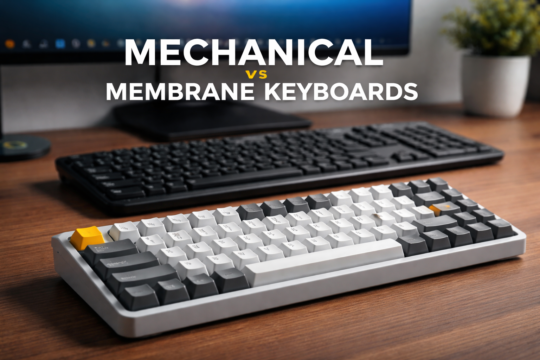
Most keyboard discussions start with the question, “Which is better?” That’s the wrong place to start.
Mechanical and membrane keyboards aren’t competing in the same way CPUs or GPUs are. They exist to serve different typing histories, different muscle memory, and different expectations about how input should feel.
If you’ve ever typed a hidden password and wondered whether a key actually registered, you already understand the real difference.
Why “Which Is Better?” Is the Wrong Question
Most reviews try to rank keyboards as if one technology replaced the other. That framing misses the point. Mechanical and membrane keyboards solve different problems for different people.
The real question isn’t which keyboard is better — it’s which one aligns with how you learned to type and what kind of feedback your hands expect.
Two Very Different Typing Upbringings
Resistance-Trained Typists (Typewriters & Early PCs)
- Required deliberate force
- Clear tactile and audible confirmation
- Muscle memory built around certainty
If you learned to type on a typewriter or early desktop keyboard, you were trained to expect physical confirmation. Keys required effort, and that effort told you the input had registered.
For these typists, membrane keyboards can feel vague. The actuation happens somewhere between “almost pressed” and “fully bottomed out,” which can introduce uncertainty — especially when typing without visual confirmation.
Light-Touch Typists (Phones, Tablets & Modern Laptops)
- Minimal key travel
- Visual confirmation replaces tactile feedback
- Speed prioritized over resistance
For people who grew up typing primarily on smartphones, tablets, or modern low-travel laptops, input works differently. Confirmation comes from the screen, not the fingers.
For these typists, mechanical keyboards can feel heavy, loud, or unnecessarily demanding. Membrane keyboards often feel more natural because they mirror the light, fast interactions they’re used to.
Why Mechanical Keyboards Feel More Accurate to Some People
Mechanical keyboards don’t magically make people faster or better at typing. What they do provide is certainty.
Each key has a defined actuation point. You feel when it triggers. That physical feedback removes doubt and reduces the mental overhead of wondering whether a keypress actually registered.
This difference becomes especially noticeable when typing passwords, working quickly without looking at the keyboard, or operating under cognitive load. When the hands receive confirmation, the brain doesn’t have to stop and question the input.
Where Membrane Keyboards Still Make Sense
- Quiet environments and shared offices
- Long typing sessions with minimal finger fatigue
- Users accustomed to light, low-resistance input
Membrane keyboards aren’t inferior — they’re optimized for comfort and subtlety. For many people, especially those working in quiet spaces or typing for extended periods, reduced resistance and noise can be more important than tactile certainty.
In these scenarios, a keyboard that stays out of the way is often the best tool for the job.
Heavy-Handed vs Light-Handed Typing (The Overlooked Factor)
Typing force is one of the most overlooked factors in keyboard choice. Some people naturally bottom out keys with every press, while others float lightly across the keyboard.
These habits aren’t right or wrong — they’re the result of years of muscle memory and learned behavior.
- Heavy-handed typists often overpower membrane keyboards, leading to missed or uncertain inputs
- Light-handed typists may find mechanical keyboards tiring or unnecessarily loud
Matching the keyboard to typing force reduces frustration more than any premium feature ever will. When the resistance matches your natural input, the keyboard disappears and the work takes over.
So Which Keyboard Should You Actually Use?
- If you expect resistance and clear feedback, a mechanical keyboard will likely feel more accurate
- If you expect softness and quiet operation, a membrane keyboard may feel more comfortable
- If you often type without looking or enter passwords frequently, tactile confirmation matters
- If you work in shared or quiet spaces, noise and fatigue matter more
The mistake most people make is buying based on hype instead of habit. A keyboard that feels “premium” to someone else can be distracting or frustrating if it doesn’t match how you type.
The best keyboard is the one that disappears while you work.
Final Thought
Mechanical and membrane keyboards aren’t better or worse — they’re built for different hands and different histories. If you find yourself thinking about the keys while you type, something isn’t matched correctly.
Choose the keyboard that feels certain to you, and let the technology fade into the background where it belongs.