I’ve run into this problem firsthand as a business owner: software with endless options but poor defaults. Go High Level is a good example. The barrier to entry for employees is high. There’s a lot it can do, but when you think about your lowest common denominator — your employee — how fast can you really expect them to adapt?
The same question applies to the owner. Will you realistically have the time to fully understand the software and use it the way it was intended? Most of the time, the answer is no. When an owner can’t confidently explain the system, or even stay aware of what’s happening inside it, onboarding becomes a struggle and the software turns into friction instead of leverage.
Features Don’t Equal Usability
This is where a lot of software goes wrong. Feature lists look impressive, but they don’t tell you how the tool behaves out of the box. Defaults matter more than most people realize. They determine how the software is actually used on day one, not how it could be used after weeks of setup and training.
When defaults are weak, the burden shifts to the user. Someone has to decide how things should work, configure it, document it, and then teach it to everyone else. In a business environment, that “someone” is usually the owner — the person with the least amount of spare time.
The Human Cost of Complexity
Employees aren’t lazy. They’re busy. If a system feels overwhelming or unclear, they’ll avoid it, misuse it, or fall back to old habits. That’s not a failure of the employee — it’s a failure of the tool to meet people where they are.
Complex software also creates quiet inefficiencies. Tasks take longer. Mistakes go unnoticed. Confidence drops. Over time, people stop trusting the system, and once that happens, adoption is almost impossible to recover.
Why Simpler Software Scales Better
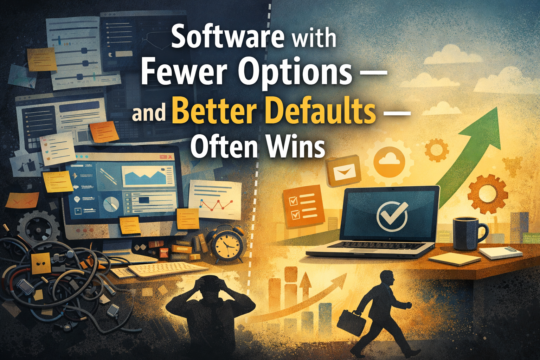
Software with fewer options but better defaults does something important: it guides behavior. It nudges users toward the right actions without needing constant oversight. It reduces decision-making at the point of use, which matters when you’re dealing with real people, real schedules, and real pressure.
On paper, these tools can look limited. In practice, they’re often used more consistently and more correctly. That consistency is where the value shows up.
The Owner’s Perspective Matters
From an owner’s standpoint, there’s another layer to this. If you don’t understand the software well enough to explain it, you can’t manage it effectively. You don’t know what’s broken, what’s being ignored, or what’s quietly causing problems behind the scenes.
Software should reduce cognitive load, not add to it. If staying oriented inside a tool requires a deep dive, it’s probably not aligned with how most businesses actually operate.
Choosing “Good Enough”
I would steer you toward “good enough.” It’s going to save you a lot of headaches in the near future. The quicker you can get your workers into a flow state in their role, the more productive they’ll be and the better they’ll feel doing it. The same thing applies if you’re a one-man show with deadlines to meet.