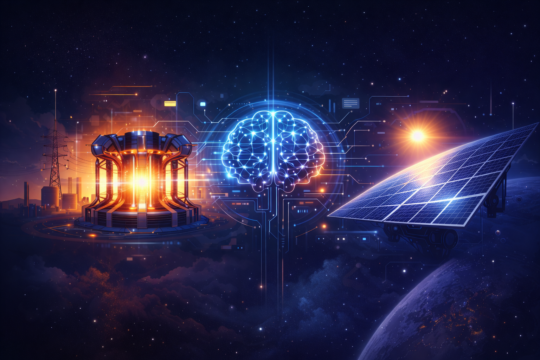
Artificial intelligence is often framed as a software race. Bigger models. Better training data. Smarter architectures.
But beneath all of that is something far less glamorous and far more decisive: energy.
As AI systems scale, the limiting factor increasingly isn’t clever algorithms — it’s access to reliable, massive, and affordable power. That’s where the connection between AI and next-generation energy sources becomes hard to ignore.
Why Sam Altman Is Betting on Fusion
Sam Altman hasn’t just talked about artificial intelligence reshaping the world. He has also invested heavily in nuclear fusion ventures such as Helion Energy.
That isn’t random diversification. It’s strategic alignment.
Training large AI models requires:
- Enormous data center infrastructure
- Continuous high-density power draw
- Stable, predictable energy pricing
Fusion, if it becomes commercially viable, promises:
- Near-limitless fuel supply
- Minimal long-lived waste
- High-output, stable baseload power
The connection is straightforward:
If AI becomes central to economies, the entities controlling scalable clean energy will have a structural advantage.
Fusion isn’t about idealism. It’s about ensuring that AI growth doesn’t hit a physical ceiling.
AI Is Already an Energy Problem
Modern AI training runs can consume staggering amounts of electricity. Even inference at scale — millions of queries per day — adds up quickly.
The more AI becomes embedded into:
- Search
- Software tools
- Autonomous systems
- Robotics
- Industrial optimization
The more energy demand grows in parallel.
The AI race is therefore not just about:
- Model quality
- Hardware acceleration
- Data pipelines
It’s also about:
- Grid stability
- Energy density
- Geographic energy access
In that sense, the “AI race” is already partially an infrastructure race.
Elon Musk and the Space Solar Argument
Elon Musk has long pushed a broader idea: that the true long-term advantage may belong to whoever can scale energy beyond Earth-based constraints.
The argument behind space-based solar power is simple in concept:
- Solar energy in orbit is uninterrupted by weather or night cycles
- Collection efficiency is dramatically higher
- Energy could theoretically be transmitted back to Earth
If space solar becomes practical, it would represent:
- Massive energy throughput
- Global distribution potential
- Independence from terrestrial grid bottlenecks
Under that framework, the AI leader isn’t just the company with the best model — it’s the one with access to effectively unlimited power.
Energy becomes the competitive moat.
Why Energy and AI Are Becoming Inseparable
As AI models become more capable, they also become more compute-intensive.
There are two paths forward:
- Improve efficiency dramatically
- Expand energy supply dramatically
In reality, both will be necessary.
Fusion addresses:
- Clean baseload power
- Long-term grid scalability
Space solar addresses:
- Energy beyond terrestrial limits
- Geographic constraints
Both ideas point toward the same conclusion:
The AI race is fundamentally constrained by physics, not just software engineering.
The Strategic Layer Most People Ignore
When large tech leaders invest in energy, it’s tempting to treat it as side interest or visionary distraction.
It’s more likely risk mitigation.
If AI becomes central to:
- Economic productivity
- Defense systems
- Logistics
- Manufacturing
- Financial systems
Then energy becomes a national and corporate strategic asset again.
In that world, the companies or nations that solve energy scaling first don’t just win an environmental milestone — they unlock AI growth at a level others can’t match.
Is This Overstated?
Possibly.
AI hardware efficiency continues to improve. New chip architectures reduce power consumption per operation. Distributed computing models evolve.
But history suggests that when a technology scales aggressively, energy supply eventually becomes the defining constraint.
Industrial revolutions have always been energy revolutions.
AI may simply be the next example.
Bottom Line
The AI race isn’t just about better models or faster chips. It’s about who can sustain exponential computation without hitting energy limits.
Sam Altman investing in fusion and Elon Musk talking about space solar aren’t unrelated threads. They’re signals that the long-term competition may hinge on energy as much as intelligence.
If that’s true, the future of AI won’t just be written in code.
It will be powered first.